Psychology · Book summary
Nudge summary
Richard Thaler and Cass Sunstein argue that the way choices are presented, from the order of food in a canteen to the default on a pension form, shapes what people choose. Since there’s no neutral way to design a choice, designers should nudge people towards better decisions while leaving them free to choose otherwise.
Nudge summary: the core argument
Nudge: Improving Decisions About Health, Wealth, and Happiness was published in 2008 by the economist Richard Thaler and the legal scholar Cass Sunstein. Thaler later won the 2017 Nobel Prize in economics for his work in behavioural economics. An updated version, Nudge: The Final Edition, came out in 2021.
The book starts from a gap between theory and reality. Traditional economics imagines Econs, perfectly rational people who weigh every option and never make predictable mistakes. Real Humans procrastinate, follow the crowd, stick with defaults and get confused by complicated forms. Those mistakes aren’t random; they’re predictable, which means they can be designed around.
Thaler and Sunstein call anyone who shapes how options are presented a choice architect: a canteen manager deciding where to put the fruit, an employer designing a pension form, a government writing a tax letter. Every one of these designs influences behaviour, whether the designer intends it or not. Since some influence is unavoidable, the authors argue, it should point people towards choices they’d make for themselves if they had full attention and information.
They call this approach libertarian paternalism. It’s paternalistic because it tries to steer people towards better outcomes, and libertarian because it never forbids any option or significantly changes incentives. A nudge must be easy and cheap to avoid. The book applies the idea to saving, health, organ donation, the environment and more, and inspired governments to set up behavioural units, starting with the UK’s Behavioural Insights Team in 2010.
Key ideas from Nudge
The book’s main ideas, each with one practical takeaway. In BrainDrop, Nudge is 9 short illustrated cards with a quick quiz at the end; this page is the written version.
1Choice architecture is everywhere
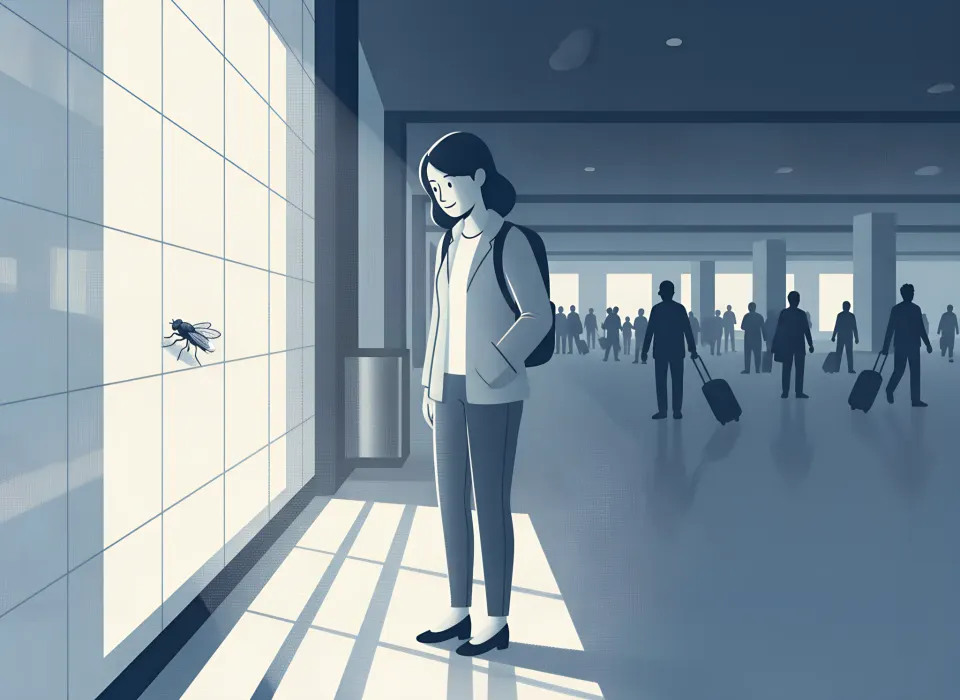
The book’s most famous example is a fly. At Amsterdam’s Schiphol Airport, an image of a fly was etched into men’s urinals. Given a target, men aimed better, and spillage reportedly fell by about eighty per cent. Nobody was told what to do; the design did the work.
The same principle applies to canteens, websites and forms. The order, wording and layout of options always influence choices.
Try this
Walk through a space you control, your kitchen, your desk or your inbox, and change one layout so the better choice is the first one you see.
2Humans, not Econs
People rely on rules of thumb, are swayed by framing, and struggle with self-control. Thaler and Sunstein show how designs can work with these quirks. On Chicago’s Lake Shore Drive, white lines painted closer and closer together before a dangerous bend make drivers feel they’re speeding up, so they slow down.
Understanding how people actually behave, rather than how they ought to, is the starting point for any good nudge.
Try this
Think of one habit you keep failing at. Instead of trying harder, ask what small change to your surroundings would make the right choice feel natural.
3We follow the herd
People are strongly influenced by what others do and think. The authors describe the ‘Don’t Mess with Texas’ campaign, which used tough-talking football players and musicians to make littering look uncool to young men, and helped cut roadside litter in the state by about seventy-two per cent within a few years.
Telling people what most others do, for example that most neighbours pay their taxes on time, can be more powerful than warnings.
Try this
If you want a group to adopt a behaviour, show them how many people like them already do it rather than lecturing about why they should.
4Defaults decide
The option that happens if you do nothing is enormously powerful. The authors compare organ donation consent in Austria, where people are donors unless they opt out, with Germany, where people must opt in. In the research they cite, consent in Austria was about ninety-nine per cent and in Germany about twelve.
Because people tend to stick with whatever is preset, choosing a sensible default is one of the most effective nudges available.
Try this
Check the defaults in your own life, such as subscriptions, pension contributions and phone settings, and change any that you’d never have chosen deliberately.
5Expect error and give feedback
Good design assumes people will make mistakes. London paints ‘Look right’ at crossings because visitors from countries that drive on the right look the wrong way. Feedback helps too: in a study the authors describe, households given a glowing ball that turned red when power use was high cut their peak-time energy use by about forty per cent.
The best systems anticipate errors and show people the consequences of their choices while they can still change them.
Try this
Add one piece of visible feedback to a goal you care about, such as a spending tracker or a step counter on your home screen.

6Save More Tomorrow
Thaler and Shlomo Benartzi designed a programme that asks workers to commit now to saving part of their future pay rises. Because the money comes from raises they don’t yet have, it doesn’t feel like a loss, and inertia keeps them enrolled. In the first company to use it, participants raised their average savings rate from 3.5 to 13.6 per cent over about three and a half years.
It’s a model of a nudge that works with human nature: procrastination and loss aversion become allies instead of obstacles.
Try this
Commit now to saving half of your next pay rise, and set it up before the rise arrives.
7More choice needs good structure
More options aren’t always better. When Sweden reformed its pension system in 2000, people were encouraged to choose from 456 funds. Many picked funds that had recently done well, including technology funds just before they fell, and lagged behind the expert-designed default.
Complex choices need structure: sensible defaults, simple comparisons and ways to narrow the options.
Try this
When a choice feels overwhelming, cut the options to three that meet your basic needs before comparing details.
8Beware of sludge
The Final Edition adds the idea of sludge: friction that makes it harder to do something in your own interest. Thaler describes signing up for a newspaper trial in seconds, then finding that cancelling required advance notice and a phone call.
Sludge is the dark mirror of a nudge. Good choice architects remove it; bad ones use it to keep people paying or to stop them claiming what they’re entitled to.
Try this
Find one subscription that’s hard to cancel and cancel it now, or set a reminder for before the next renewal.
Nudge quotes
Quoted from the book and checked against it.
“A choice architect has the responsibility for organizing the context in which people make decisions.”
“A crucial parallel is that there is no such thing as a “neutral” design.”
Who should read Nudge?
Nudge is for anyone who designs choices for others: managers, policymakers, product designers, marketers, teachers and parents. It’s also useful for anyone who wants to understand why they keep making the same money and health mistakes.
If you want the deeper psychology behind it, Daniel Kahneman’s Thinking, Fast and Slow goes further. If you’ve only time for one edition of Nudge, the Final Edition (2021) is the most up to date.
Criticisms of Nudge
Some critics see nudging as manipulation, arguing that steering people without their awareness is disrespectful even when it’s well meant, and that it lets governments avoid harder reforms. Others worry about who decides what counts as a better choice.
There are also doubts about how well nudges work. Large analyses of real-world government trials have found effects much smaller than those reported in academic studies, and a 2022 analysis argued that, once publication bias is accounted for, the evidence for nudges in general is weak. Defenders reply that nudges are cheap, so even small effects across millions of people can be worthwhile, and that well-designed defaults like pension auto-enrolment have clearly worked.
Books like Nudge
Nudge summary: questions
What is the main idea of Nudge?
That the way choices are presented shapes decisions, so choice architects should design them to steer people towards better outcomes while leaving them free to choose.
What is a nudge?
Any feature of how a choice is presented that changes behaviour predictably without forbidding options or significantly changing financial incentives, such as a default, a reminder or the order items appear in.
What is choice architecture?
The design of the context in which people make decisions, such as the layout of a canteen, the defaults on a form or the wording of a letter.
What is libertarian paternalism?
Thaler and Sunstein’s term for steering people towards choices that benefit them (paternalism) while keeping every option open and easy to choose (libertarian).
Is Nudge worth reading?
Yes, if you design products, policies or processes, or want to understand everyday decision mistakes. The Final Edition is the best version to read now.
Nudge vs Thinking, Fast and Slow: which should I read?
Thinking, Fast and Slow explains the psychology of judgement in depth. Nudge is shorter and more practical, focused on designing better choices. Many readers start with Nudge.
Read Nudge as illustrated cards in BrainDrop
The 9 ideas from Nudge, each told as a short illustrated story with one small thing to try today, then a quick quiz to make it stick. Free to download, with a free trial.
- Choice Architecture Is Everywhere
- Humans, Not Econs
- We Follow the Herd
- Defaults Decide
- Expect Error
- Feedback Changes Behavior
- Beware of Sludge
- Save More Tomorrow
- More Choice Needs Good Defaults
Choosing an app?
Self-improvement apps that make learning stick · BrainDrop vs Deepstash · Best book summary apps in 2026