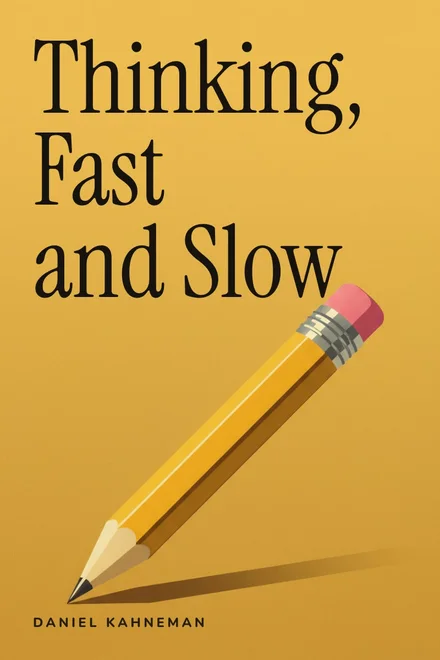
Psychology · Book summary
Thinking, Fast and Slow summary
Your fast, intuitive mind is often confidently wrong.
Your mind has two systems, and the fast one is often wrong.
Thinking, Fast and Slow key ideas
In BrainDrop, each idea is a short illustrated story with one small thing to try today and a quick quiz. Here are the headlines.
System 1 vs. System 2
Your fast mind jumps to answers; your slow mind checks them. Notice when to slow down.
Anchoring Effect
The first number you see sways your judgment. Question where your anchor came from.
Loss Aversion
Losses feel about twice as big as equal gains. Weigh both sides fairly.
Overconfidence Bias
Feeling confident isn't the same as being right. Check your track record, not your feelings.
The Halo Effect
One good impression colors everything else. Judge each trait separately.
Framing Effect
The same facts framed differently lead to different choices. Restate decisions both ways.
Availability Heuristic
We overrate what comes to mind easily. Look for the examples you can't recall.
Sunk Cost Fallacy
Past costs are gone. Decide based on what's best from here.
Mental Accounting
Money is money. Look at your finances as a whole, not in separate mental boxes.
Thinking, Fast and Slow summary: questions
What is Thinking, Fast and Slow about?
Thinking, Fast and Slow by Daniel Kahneman in one line: Your fast, intuitive mind is often confidently wrong.
What are the key ideas in Thinking, Fast and Slow?
BrainDrop tells Thinking, Fast and Slow as 9 key ideas: System 1 vs. System 2; Anchoring Effect; Loss Aversion; Overconfidence Bias; The Halo Effect; Framing Effect; Availability Heuristic; Sunk Cost Fallacy; Mental Accounting.
Is there a free Thinking, Fast and Slow summary?
Yes: this page lists every key idea from Thinking, Fast and Slow for free. The full illustrated stories are in the BrainDrop app, free to download with a free trial, then BrainDrop Pro.
Read the full stories in BrainDrop
Every idea from Thinking, Fast and Slow, told as an illustrated story you swipe through in minutes. Free to download, with a free trial.
More psychology books





Choosing an app?
Self-improvement apps that make learning stick · BrainDrop vs Imprint · Best book summary apps in 2026