Philosophy · Book summary
The Black Swan summary
Nassim Nicholas Taleb argues that history is driven by rare, high-impact events nobody saw coming, which we then explain away as obvious. Our minds and models are built for a tame world of averages, so we badly underestimate the extremes. The answer isn’t better forecasting but preparing for what you can’t predict.
The Black Swan summary: the core argument
The Black Swan: The Impact of the Highly Improbable was published in 2007 and became famous when the financial crisis of 2008 seemed to prove its point. A second edition in 2010 added a long essay, On Robustness and Fragility, which grew into his later book Antifragile.
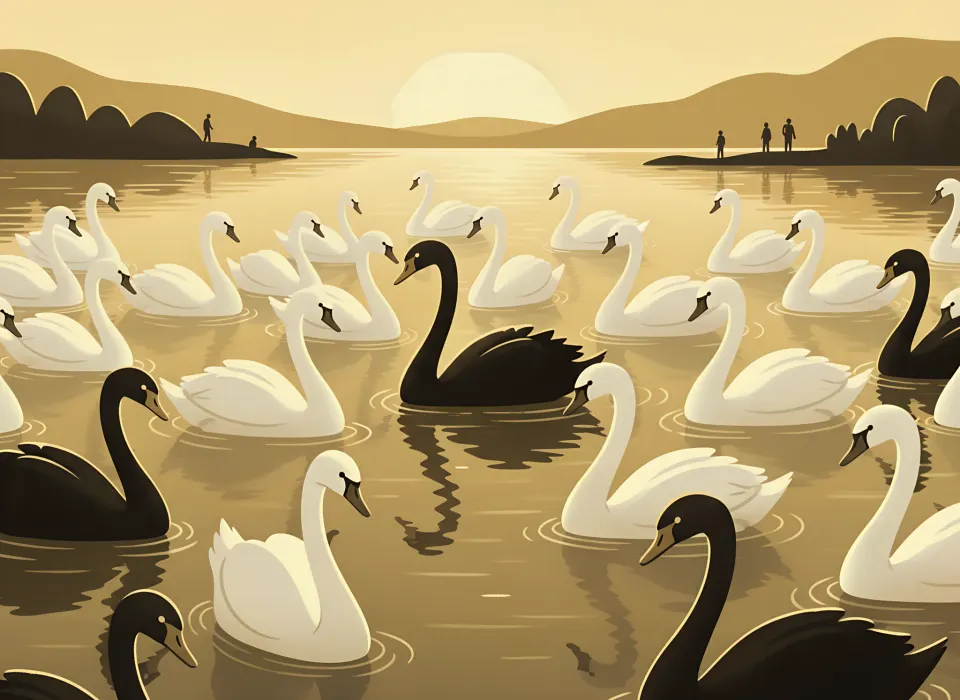
The title comes from an old philosophical example. Europeans long assumed all swans were white, because every swan they had seen was white. Then black swans were found in Australia, and centuries of observations were overturned by one sighting. Taleb defines a Black Swan event by three features: it is an outlier that nothing in the past pointed to, it has an extreme impact, and afterwards we invent explanations that make it seem predictable.
His examples include the First World War, the rise of the internet, the attacks of 11 September 2001 and many market crashes. The argument is that a small number of such events explain most of what matters in history, finance, science and careers, while our tools, from the bell curve to expert forecasts, are designed for a world where extremes are rare and small.
Taleb is scathing about people who claim to predict that world: economists, analysts, risk managers. His alternative is humility and preparation. Accept that you can’t see the big events coming, protect yourself from the negative ones, and put yourself in the path of the positive ones.
Key ideas from The Black Swan
The book’s main ideas, each with one practical takeaway. In BrainDrop, The Black Swan is 9 short illustrated cards with a quick quiz at the end; this page is the written version.
1What a Black Swan is
A Black Swan is rare, has an enormous impact, and seems obvious only in hindsight. The last part matters most. After a crash or a war, commentators produce tidy explanations, which convinces us we could have seen it coming and leaves us just as unprepared for the next one.
Black Swans can be good as well as bad: a chance meeting, a runaway bestseller or an accidental scientific discovery.
Try this
Think of the biggest turning point in your life so far. How much of it did you plan, and how much came from an event you couldn’t have predicted?
2The antilibrary: value what you don’t know
Taleb opens with the writer Umberto Eco, who owned tens of thousands of books. Visitors asked how many he had read, missing the point: the unread books were the valuable ones, a constant reminder of everything he didn’t know. Taleb calls this an antilibrary.
The lesson is to treat knowledge as a growing awareness of your ignorance, not a stock of answers.
Try this
Keep a list of questions you can’t answer about your work or field, and add to it rather than only crossing things off.
3Mediocristan and Extremistan
Taleb divides the world into two kinds of territory. In Mediocristan, no single case can change the total much. Add the tallest person on Earth to a room of a thousand people and the average height barely moves. Averages and bell curves work well here.
In Extremistan, one case can outweigh all the rest. Add the world’s richest person to the same room and they may hold nearly all the wealth. Book sales, company sizes, war deaths and market moves live in Extremistan, where averages mislead and the extremes are the whole story.
Try this
For a decision you’re facing, ask whether the outcomes behave like height (bounded) or like wealth (unbounded), and plan for the extremes if it’s the second.
4The turkey problem
A turkey is fed every day for a thousand days. Each day strengthens its belief that humans are kind and its life is safe. Its confidence is highest on the day before Thanksgiving, when everything changes.
Taleb borrows the idea from Bertrand Russell’s chicken. The lesson is that a long record of safety can be the very thing that blinds you to risk, especially when someone else controls the outcome.
Try this
Pick something you assume is safe because ‘it’s always been fine’. Ask what would have to change for it not to be.
5The narrative fallacy
Our minds love stories, so we connect facts into a cause-and-effect chain even when the link is weak. Taleb notes that on the day Saddam Hussein was captured, news headlines used the capture to explain bond prices going up, then going down, within hours.
Stories make the world feel more understandable and predictable than it is. The fix is to be suspicious of neat explanations, especially ones offered after the fact.
Try this
The next time you read ‘markets fell because…’, ask whether the explanation could equally have explained the opposite move.

6Silent evidence
We judge by what survived and ignore what didn’t. Taleb retells Cicero’s story of Diagoras, who was shown portraits of sailors who had prayed and survived a shipwreck. He asked where the portraits were of those who prayed and drowned.
The same bias makes successful entrepreneurs’ habits look like the cause of their success, when thousands of failures with the same habits are invisible.
Try this
Before copying someone’s success story, look for people who did the same thing and failed.
7Real life isn’t a casino
Taleb calls the ludic fallacy the mistake of treating life like a game with known rules and odds. A casino can model its gambling risks precisely. He describes how a Las Vegas casino’s biggest losses came from events outside those models, including a performer mauled by his tiger.
Real-world risk often comes from places your model doesn’t include at all.
Try this
List the risks you plan for in one project, then spend a few minutes listing risks from completely outside that list.
8Prepare instead of predicting, and seek positive Black Swans
We are poor at forecasting, and experts are often no better than chance in complex areas. The Sydney Opera House, planned to open in 1963 for about seven million Australian dollars, opened in 1973 at over a hundred million.
Taleb’s advice is to limit your exposure to negative Black Swans and maximise exposure to positive ones: go to parties, try many small experiments, say yes to chance encounters, and invest a small part of your resources in things with huge upside.
Try this
Say yes to one unplanned opportunity this month, a talk, an introduction or a side project, that costs little if it goes nowhere.
The Black Swan quotes
Quoted from the book and checked against it.
“Read books are far less valuable than unread ones.”
“Missing a train is only painful if you run after it!”
How the book is structured
The Black Swan has a prologue and four parts. The second edition adds a postscript essay.
- Part One: Umberto Eco’s antilibrary, or how we seek validation Why we are blind to Black Swans: the turkey problem, confirmation bias, the narrative fallacy and silent evidence.
- Part Two: We just can’t predict The scandal of prediction, why experts and plans fail, and how much of discovery is accidental.
- Part Three: Those grey swans of Extremistan Mediocristan and Extremistan, the limits of the bell curve and the alternative of fractal randomness.
- Part Four: The end A short, personal close on living with uncertainty.
- Postscript: On Robustness and Fragility (second edition) Taleb answers critics and sets out ideas he developed further in Antifragile.
Who should read The Black Swan?
The Black Swan suits anyone who makes decisions under uncertainty: investors, founders, managers, planners and anyone who reads forecasts. It changes how you read the news.
It’s denser and more philosophical than most popular non-fiction. If you want the practical toolkit rather than the diagnosis, Antifragile is the better starting point.
Criticisms of The Black Swan
Statisticians and economists have pushed back on Taleb’s attacks on the bell curve, arguing that professionals already use fat-tailed models and that he caricatures their work. His tone, which dismisses whole professions, puts many readers off.
Others note that not all forecasting is hopeless. Philip Tetlock’s research, described in Superforecasting, shows some people forecast short-term events reliably better than chance. And because Black Swans are unpredictable by definition, critics say the advice can be hard to act on. Taleb’s reply is that you don’t need to predict them, only to avoid being fragile to them.
Books like The Black Swan
The Black Swan summary: questions
What is a Black Swan event?
An event that is rare and unexpected, has an extreme impact, and is explained afterwards as if it had been predictable. Examples Taleb discusses include the First World War, the rise of the internet and the attacks of 11 September 2001.
What is the main lesson of The Black Swan?
Stop relying on predictions about rare events. Reduce your exposure to the damaging ones and increase your exposure to the beneficial ones.
What is the difference between Mediocristan and Extremistan?
In Mediocristan, like height or weight, no single case changes the total much. In Extremistan, like wealth or book sales, one extreme case can outweigh all the others.
Did The Black Swan predict the 2008 financial crisis?
It didn’t predict the crisis itself, but it warned that banks and risk models were fragile to rare, large losses, and the crisis that followed in 2008 made the book famous.
Is The Black Swan worth reading?
Yes, if you want to think more clearly about risk and uncertainty. It is dense and opinionated, so many readers prefer a summary first.
The Black Swan vs Antifragile: which should I read?
The Black Swan explains why rare events dominate and why we can’t predict them. Antifragile is about what to do in response. Read The Black Swan first if you want the full argument.
Read The Black Swan as illustrated cards in BrainDrop
The 9 ideas from The Black Swan, each told as a short illustrated story with one small thing to try today, then a quick quiz to make it stick. Free to download, with a free trial.
- What a Black Swan Is
- The Antilibrary
- Mediocristan and Extremistan
- The Turkey Problem
- The Narrative Fallacy
- Silent Evidence
- Real Life Isn’t a Casino
- We Can’t Predict
- Seek Positive Black Swans
Choosing an app?
Self-improvement apps that make learning stick · BrainDrop vs Instaread · Best book summary apps in 2026