Philosophy · Book summary
Antifragile summary
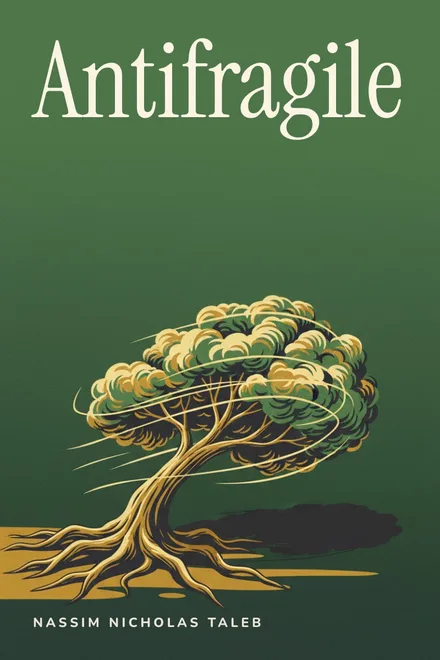
Nassim Nicholas Taleb argues that some things don’t just survive shocks but gain from them. Bones, muscles, evolution and good businesses get stronger with stress; smooth, over-protected systems hide risk until they break. Stop trying to predict the future and build things that benefit from not knowing it.
Antifragile summary: the core argument
Antifragile: Things That Gain from Disorder, published in 2012, is the fourth book in Taleb’s Incerto series, after Fooled by Randomness and The Black Swan. Those books argued that rare, unpredictable events shape the world. Antifragile asks the practical question that follows: if you can’t predict the shocks, how should you live and build?
Taleb’s answer starts with a missing word. We have a word for things that break under stress (fragile) and for things that withstand it (robust or resilient), but no word for things that get better. He coins one: antifragile. In myth, the sword hanging over Damocles is fragile, the Phoenix that rises from its ashes is robust, and the Hydra, which grows two heads for each one cut off, is antifragile.
Once you see the triad, it shows up everywhere. Muscles grow from the stress of lifting. Restaurants fail all the time, which keeps the restaurant trade as a whole excellent. Small, frequent shocks keep systems honest, while attempts to remove all volatility, through bailouts, constant medical intervention or smoothed-out careers, store up hidden fragility that later breaks all at once.
The practical advice follows from that. Avoid exposure to big downside you can’t survive. Keep small, cheap options with large upside. Remove harmful things before adding clever ones. Trust what has survived a long time. And make sure people who take risks bear the consequences when they go wrong. Taleb tells all this through essays, history and two recurring characters, the street-smart trader Fat Tony and the bookish Nero Tulip.

Key ideas from Antifragile
The book’s main ideas, each with one practical takeaway. In BrainDrop, Antifragile is 9 short illustrated cards with a quick quiz at the end; this page is the written version.
1Fragile, robust and antifragile
A simple test separates the three. Ask what happens when there is more volatility, more randomness or more stress. If it gets worse, it’s fragile, like a glass parcel. If it stays the same, it’s robust. If it gets better, it’s antifragile.
The test applies to people, companies, governments and ideas. Taleb’s point is that we spend too much effort trying to predict events and too little making ourselves less fragile to them.
Try this
List three things you depend on: income, health, home. For each, ask whether a shock would harm it, leave it unchanged or improve it.
2Small stressors make you stronger
Many living systems need stress to stay healthy. Bones lose density without load, and the immune system learns from exposure. Taleb cites the legend of King Mithridates, who was said to protect himself from poisoning by taking small doses of poison.
The key word is small. The right dose, followed by recovery, builds strength; a dose too large simply breaks you.
Try this
Add one manageable stressor to your week, such as a harder workout, a cold shower or a difficult conversation, and allow time to recover.
3Smooth lives hide big risks
Taleb contrasts two brothers. John has a steady salaried job at a bank; George drives a taxi and earns a different amount every day. John looks safer, but his income depends on one employer, and one layoff takes it to zero. George faces small daily ups and downs, learns constantly and is never wiped out by a single event.
The same logic applies to economies and institutions that suppress small failures. The volatility doesn’t disappear; it builds up and arrives as one large crisis.
Try this
Find one place in your life where you rely on a single source, such as one client, one skill or one employer, and add a second.
4The barbell strategy
Instead of putting everything into medium-risk options, Taleb recommends a barbell: keep most of your resources extremely safe, and put a small part into bold bets with large possible upside. The safe end protects you from ruin; the risky end exposes you to good surprises.
He applies it beyond money. A writer might keep a dull, secure day job and write ambitious work on the side.
Try this
Split one area of your life, money or time, into a very safe majority and a small, bold experiment you can afford to lose.
5Options beat predictions
Taleb retells Aristotle’s story of the philosopher Thales, who paid small deposits for the use of olive presses before a harvest. When the harvest was large, presses were in demand and Thales profited. He didn’t need to forecast the harvest precisely; he needed a cheap option that paid if things went well.
Optionality, having the right but not the obligation to act, lets you benefit from uncertainty instead of guessing it correctly.
Try this
Look for a cheap option in your work, a small trial, a side project or a reversible step, rather than one big committed bet.

6Via negativa: subtract before you add
Often the most reliable improvement comes from removing things: bad habits, unnecessary medication, toxic relationships, needless rules. Taleb calls this via negativa. Adding interventions brings side effects nobody predicted; removing harmful ones rarely does.
He warns about iatrogenics, harm caused by the healer, such as treating mild conditions so aggressively that the treatment does more damage than the illness.
Try this
Before buying or adding anything to fix a problem this week, ask what you could take away instead.
7Time is the best judge
The Lindy effect, as Taleb uses it, says that for non-perishable things like books, ideas and technologies, every year they survive adds to their expected remaining life. A book still read after a century is likely to be read for another century; a bestseller from last year may vanish.
This makes old, tested things a safer bet than new, untested ones, at least when the downside of being wrong is large.
Try this
Balance your reading or tools this month: for every new thing you try, pick one that has lasted decades.
8Skin in the game
Taleb’s ethical point is that systems become fragile when people get the upside of risk while others carry the downside. He cites Hammurabi’s ancient Babylonian law, under which a builder whose house collapsed and killed the owner could be put to death.
Bankers paid bonuses on risky bets that taxpayers later covered are his modern example. He developed the idea further in his later book Skin in the Game.
Try this
Before taking advice, ask what the adviser loses if they’re wrong. Give more weight to people who share the risk.
Antifragile quotes
Quoted from the book and checked against it.
“Wind extinguishes a candle and energizes fire.”
“Antifragility is beyond resilience or robustness. The resilient resists shocks and stays the same; the antifragile gets better.”
Who should read Antifragile?
Antifragile is for readers interested in risk, decision-making, investing, health or how institutions fail. If you liked The Black Swan, this is the practical follow-up.
It is long, digressive and opinionated. Readers who want a tidy self-help book may prefer to start with a summary and dip into the chapters that interest them.
Criticisms of Antifragile
The most common complaint is style. Taleb is combative, frequently insults economists, journalists and academics, and wanders between topics. Some readers find this entertaining; many find it tiring.
Critics also say the concept is stretched too far, applied to everything from diet to politics with anecdotes rather than data. Some of his health and nutrition claims are more confident than the evidence supports. Supporters answer that the core idea, judging things by how they respond to stress rather than by forecasts, is genuinely useful.
Books like Antifragile

Antifragile summary: questions
What is the main idea of Antifragile?
Some things gain from shocks, stress and uncertainty. Instead of trying to predict the future, build your life and work so that volatility helps you more than it hurts you.
What is the difference between robust and antifragile?
Something robust stays the same under stress. Something antifragile gets better. A rock is robust; a muscle that grows after exercise is antifragile.
What is the barbell strategy?
Keeping most of your resources very safe while putting a small share into high-risk, high-reward bets, and avoiding the middle. You can’t be ruined, but you can benefit from rare good surprises.
What is the Lindy effect?
The idea that for non-perishable things such as books and ideas, the longer they have survived, the longer they are likely to keep surviving.
Is Antifragile worth reading?
Yes, if you are interested in risk and uncertainty and can tolerate a long, opinionated book. If not, a summary gives you the core ideas.
Should I read The Black Swan or Antifragile first?
The Black Swan explains the problem of rare, unpredictable events; Antifragile offers the response. Reading them in that order works best, but Antifragile stands on its own.
Read Antifragile as illustrated cards in BrainDrop
The 9 ideas from Antifragile, each told as a short illustrated story with one small thing to try today, then a quick quiz to make it stick. Free to download, with a free trial.
- Beyond Resilience
- Small Doses Make You Stronger
- Smooth Lives Hide Big Risks
- Sometimes Doing Less Is Best
- The Barbell Strategy
- Options Beat Predictions
- Tinkering Beats Theory
- Time Is the Best Judge
- Skin in the Game
Choosing an app?
Self-improvement apps that make learning stick · BrainDrop vs getAbstract · Best book summary apps in 2026