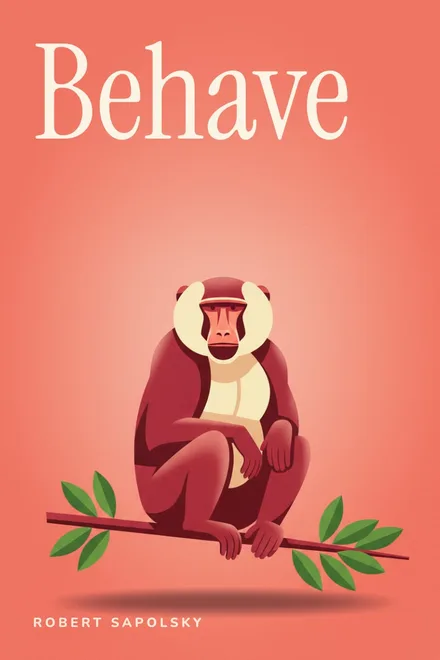
Science · Book summary
Behave summary
Every behavior has causes, from neurons to evolution.
To explain one act, look a second before it, then a year, then a million years.
Behave key ideas
In BrainDrop, each idea is a short illustrated story with one small thing to try today and a quick quiz. Here are the headlines.
The Brain Does the Harder Thing
One second before. to explain any act, Sapolsky starts with the brain in the moment, where the amygdala fires up fear and anger and the frontal cortex reins them in.
Split-Second Cues Shape Us
Seconds before. sights, sounds and smells shape behavior before we notice them, and the amygdala can trigger alarm in a fraction of a second.
Testosterone Amplifies, Not Dictates
A myth busted. in Christoph Eisenegger's 2010 study, women given testosterone made fairer offers in a bargaining game, while those who only believed they'd had it acted stingier.
The Teenage Brain Is Unfinished
The last region to mature. the frontal cortex isn't fully wired until about age 25, while the reward system peaks in adolescence, so teens' brakes lag behind their accelerator.
Life Before Birth Leaves a Mark
The womb matters. people who were fetuses during the 1944–45 Dutch Hunger Winter had more obesity, diabetes and heart disease decades later.
Genes Depend on Environment
The warrior gene myth. in Avshalom Caspi's 2002 Dunedin study, a low-activity MAOA variant predicted antisocial behavior mainly in men who had been mistreated as children.
Cultures of Honor
The hallway insult. in Nisbett and Cohen's study, Southern students who were bumped and insulted showed bigger hormone spikes and more aggression than Northerners.
Us Versus Them Comes Easily
Minimal groups. in Henri Tajfel's experiments, boys split by a supposed taste in paintings favored their own group even when it cost everyone.
Rethinking Blame
A chain of causes. any act traces back through brain, hormones, childhood, culture and evolution, none of which we chose, as Charles Whitman's brain tumor starkly suggests.
Behave summary: questions
What is Behave about?
Behave by Robert Sapolsky in one line: Every behavior has causes, from neurons to evolution.
What are the key ideas in Behave?
BrainDrop tells Behave as 9 key ideas: The Brain Does the Harder Thing; Split-Second Cues Shape Us; Testosterone Amplifies, Not Dictates; The Teenage Brain Is Unfinished; Life Before Birth Leaves a Mark; Genes Depend on Environment; Cultures of Honor; Us Versus Them Comes Easily; Rethinking Blame.
How long does Behave take in BrainDrop?
About 4–5 min. It's 9 short illustrated ideas, each with one small thing to try today, then a quick quiz. Tap Ask BrainDrop on any idea to go deeper.
Is there a free Behave summary?
Yes: this page lists every key idea from Behave for free. The full illustrated stories are in the BrainDrop app, free to download with a free trial, then BrainDrop Pro.
Read the full stories in BrainDrop
Every idea from Behave, told as an illustrated story you swipe through in minutes. Free to download, with a free trial.
More science books
Choosing an app?
The best book summary apps in 2026, compared · BrainDrop vs Blinkist · Best book summary apps in 2026