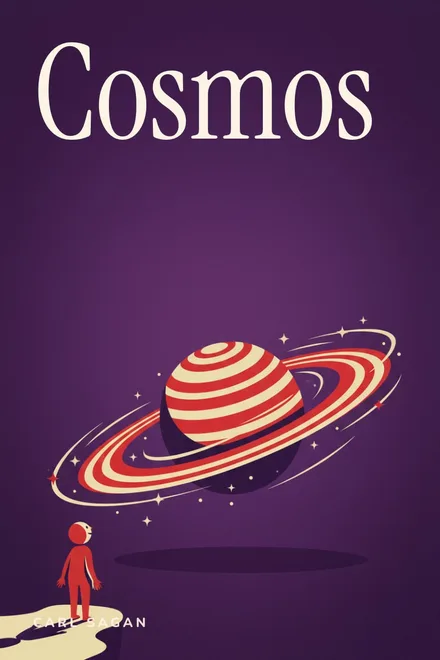
Science · Book summary
Cosmos summary
Science reveals our humble, wondrous place among the stars.
We are made of star stuff, and we're how the universe gets to know itself.
Cosmos key ideas
In BrainDrop, each idea is a short illustrated story with one small thing to try today and a quick quiz. Here are the headlines.
Eratosthenes Measured the Earth
Shadows reveal a globe. noticing that sticks cast different noon shadows in Syene and Alexandria, Eratosthenes calculated Earth's circumference with striking accuracy.
Life Shares One Chemistry
Selection shapes form. Japanese Heike crabs with shells resembling warrior faces survived as fishermen threw them back, a vivid case of unconscious artificial selection.
Kepler Chose Data Over Beauty
Tycho's precious records. Kepler inherited Tycho Brahe's precise observations of the planets, and they stubbornly refused to fit perfect circular orbits.
Venus Warns About Greenhouses
A runaway greenhouse. a thick carbon dioxide atmosphere traps heat on Venus until its surface is hot enough to melt lead.
Mars and Wishful Thinking
Lowell's imaginary canals. Percival Lowell mapped canals on Mars and imagined a dying civilization, seeing what he hoped to see rather than what was there.
We Are Made of Star Stuff
Elements forged in stars. the carbon in our cells, calcium in our bones, and iron in our blood were created inside stars that exploded long ago.
The Ionian Awakening
Nature follows laws. Greek thinkers on the Ionian coast, like Thales and Democritus, sought natural explanations instead of blaming the whims of gods.
The Drake Equation
Estimating other civilizations. Frank Drake's equation multiplies factors like star formation, habitable planets, and emergence of intelligence to estimate how many civilizations exist.
Who Speaks for Earth?
Science or self-destruction. Sagan warned that nuclear arsenals could erase civilization, and that growing knowledge demands growing responsibility.
Cosmos summary: questions
What is Cosmos about?
Cosmos by Carl Sagan in one line: Science reveals our humble, wondrous place among the stars.
What are the key ideas in Cosmos?
BrainDrop tells Cosmos as 9 key ideas: Eratosthenes Measured the Earth; Life Shares One Chemistry; Kepler Chose Data Over Beauty; Venus Warns About Greenhouses; Mars and Wishful Thinking; We Are Made of Star Stuff; The Ionian Awakening; The Drake Equation; Who Speaks for Earth?.
How long does Cosmos take in BrainDrop?
About 4–5 min. It's 9 short illustrated ideas, each with one small thing to try today, then a quick quiz. Tap Ask BrainDrop on any idea to go deeper.
Is there a free Cosmos summary?
Yes: this page lists every key idea from Cosmos for free. The full illustrated stories are in the BrainDrop app, free to download with a free trial, then BrainDrop Pro.
Read the full stories in BrainDrop
Every idea from Cosmos, told as an illustrated story you swipe through in minutes. Free to download, with a free trial.
More science books
Choosing an app?
The best book summary apps in 2026, compared · BrainDrop vs Instaread · Best book summary apps in 2026