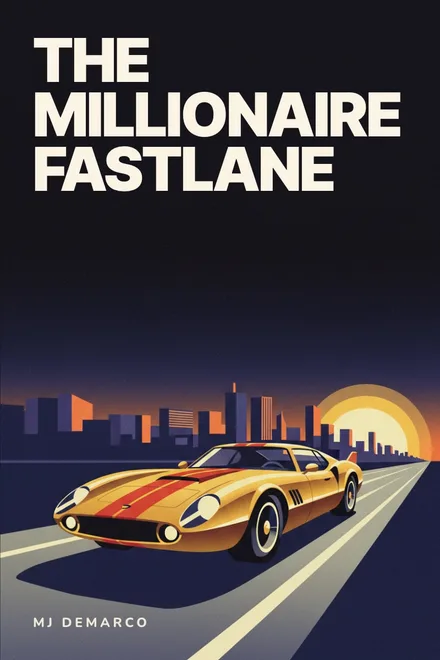
Money · Book summary
The Millionaire Fastlane summary
MJ DeMarco argues that the usual advice, get a job, save, invest and retire at sixty-five, trades your best years for a slow, uncertain payoff. His alternative, the Fastlane, is to build a business that solves a problem for many people and can earn without your hours, so wealth can come while you’re young enough to enjoy it.
The Millionaire Fastlane summary: the core argument
The Millionaire Fastlane: Crack the Code to Wealth and Live Rich for a Lifetime was self-published by MJ DeMarco in 2011. DeMarco built and sold Limos.com, an online limousine booking service, and the book is his case against what he sees as the default financial script.
He describes three roads. On the Sidewalk, people spend everything they earn and stay stuck, however much they make. On the Slowlane, people do everything the experts recommend: get a good job, live frugally, put money into index funds and wait decades for compounding. On the Fastlane, people build systems, usually businesses, whose income isn’t tied to their time.
DeMarco’s main objection to the Slowlane is that it depends on things you don’t control: your employer, the stock market, your health and your lifespan. A job caps your income because you can only sell so many hours, and the reward arrives when you’re old. The Fastlane, by contrast, links income to how many people you help and how much value you add, and it can grow far faster.
The book insists this is a process, not an event. The stories of overnight success usually hide years of failed attempts, hard work and risk. Much of the book is about the mindset that keeps people going through that process, and the criteria that make a business a genuine Fastlane rather than just another job you own.

Key ideas from The Millionaire Fastlane
The book’s main ideas, each with one practical takeaway. In BrainDrop, The Millionaire Fastlane is 9 short illustrated cards with a quick quiz at the end; this page is the written version.
1Reject the Slowlane
DeMarco calls the Slowlane a plan to be rich when you’re old. You trade five days of work for two days off, and forty years of saving for a retirement you hope to be healthy enough to enjoy. The maths works only if the market cooperates and you stay employed.
His point isn’t that saving is bad, but that it shouldn’t be your only strategy.
Try this
Work out how many years of your current saving it would take to reach financial independence. Ask whether that timeline is one you’re happy with.
2Create value for many people
Money, in DeMarco’s view, is a by-product of solving problems. Instead of asking how to make money, ask what need you can meet, and for how many people. One of his memorable lines is that if millions seek you, you’ll be paid millions.
This shifts the focus from your own wants to your customers’ problems, which DeMarco sees as the real engine of wealth.
Try this
List three problems people around you complain about. For each, note how many others might share it.
3Own a system, not a job
A job sells your time, which is limited. A business you own can earn when you’re not working, through staff, software, products or rental income. DeMarco calls these money trees: systems that keep producing after the work of building them.
He lists five kinds of Fastlane business: renting systems (property, licences), computer and software systems, content systems (books, media), distribution systems and human resource systems.
Try this
Look at what you do for work and ask which part of it could be turned into a product, a template or a process that earns without you present.
4Test ideas against CENTS
DeMarco’s checklist for a Fastlane business spells CENTS. Control: you, not a third party, run the business. Entry: it’s hard to start, so not everyone can copy you. Need: it solves a real problem. Time: it can be detached from your hours. Scale: it can reach many people.
Plenty of popular ideas fail the test. Drop-shipping on someone else’s platform fails Control and Entry; a one-person consultancy fails Time.
Try this
Score one business idea you have from zero to two on each letter of CENTS and see which weakness to fix first.
5Leverage technology and scale
Because a Fastlane business is meant to reach many people, technology matters. Software, websites and automated distribution let one small team serve thousands, so income can grow far faster than hours worked.
DeMarco puts it as a simple equation: profit comes from units sold times profit per unit, and scale raises the first number without limit.
Try this
Pick one manual task in your work and look for a tool or process that would let you do it for ten times as many people.

6Wealth is a process, not an event
We see the lottery winner, the sale of a company or the viral product, and miss the years of grind behind it. DeMarco argues that this illusion of overnight success makes people impatient and pushes them towards get-rich-quick schemes.
Committing to the process means accepting failed attempts, learning from them and staying in the game long enough to get lucky.
Try this
Choose one long-term project and commit to a small daily action for ninety days before judging it.
7Execute instead of planning
Ideas, DeMarco says, are cheap; execution is what gets paid. Endless research, business plans and waiting for the perfect moment are forms of avoidance.
Start small, put something in front of real customers and let their feedback teach you. Mistakes made in the market are more useful than plans made in private.
Try this
Take one idea you keep thinking about and ship the smallest version to a real person this week.
8Guard your time and invest in yourself
Time is the one asset you can’t earn back, so DeMarco urges readers to value it highly and to avoid spending it on things that don’t move them forward. He is also wary of status spending: flashy cars and clothes bought on credit slow you down.
The best investment, he argues, is in your own knowledge and skills, because those compound for the rest of your life.
Try this
Audit one week of your evenings: how many hours went to consuming and how many to building or learning?
The Millionaire Fastlane quotes
Quoted from the book and checked against it.
“Instead of digging for gold, sell shovels.”
“If millions seek you, you will be paid millions.”
Who should read The Millionaire Fastlane?
The Millionaire Fastlane suits people who feel stuck in a job and want a different way of thinking about money, especially those considering starting a business. It’s energetic and motivating.
It’s less useful if you want detailed, step-by-step instructions for building a company, or if you are happy with steady employment and long-term investing. Pair it with a practical startup book such as The Lean Startup or The Mom Test.
Criticisms of The Millionaire Fastlane
Critics say the book is unfair to the Slowlane. Saving and index investing have made millions of ordinary people financially secure, and DeMarco’s dismissal of them may push readers into risky ventures. Most new businesses fail, and the book can understate that risk.
Others find the tone aggressive and repetitive, and point to survivorship bias: DeMarco succeeded, but many who followed the same path didn’t. The book also promotes his online forum. Still, many readers credit it with changing how they think about time, value and ownership.
Books like The Millionaire Fastlane



The Millionaire Fastlane summary: questions
What is the main idea of The Millionaire Fastlane?
That you can build wealth much faster by owning a business system that solves problems for many people than by working a job and investing slowly for decades.
What are the Sidewalk, Slowlane and Fastlane?
The Sidewalk is spending everything you earn. The Slowlane is the traditional plan of a job, frugal living and long-term investing. The Fastlane is building a business whose income isn’t tied to your time.
What does CENTS stand for?
Control, Entry, Need, Time and Scale: DeMarco’s five tests for whether a business can become a Fastlane.
Is The Millionaire Fastlane worth reading?
Yes, if you want a jolt of motivation and a different view of money and work. Balance it with sources that take saving, investing and business risk seriously.
The Millionaire Fastlane vs Rich Dad Poor Dad: which is better?
Rich Dad Poor Dad focuses on assets and financial education, often through property. The Millionaire Fastlane focuses on building scalable businesses. Many readers start with Rich Dad Poor Dad and find Fastlane more practical about business.
Who is MJ DeMarco?
An American entrepreneur who founded and sold Limos.com, and the founder of the Fastlane online forum.
Read The Millionaire Fastlane as illustrated cards in BrainDrop
The 9 ideas from The Millionaire Fastlane, each told as a short illustrated story with one small thing to try today, then a quick quiz to make it stick. Free to download, with a free trial.
- Reject the Slow Lane
- Create Value, Not Just Income
- Embrace Entrepreneurship
- Invest in Yourself
- Understand Financial Literacy
- Think Like a Millionaire
- Leverage Technology
- Prioritize Action Over Planning
- Network with Purpose
Choosing an app?
Free book summary apps for iPhone · BrainDrop vs getAbstract · Best book summary apps in 2026