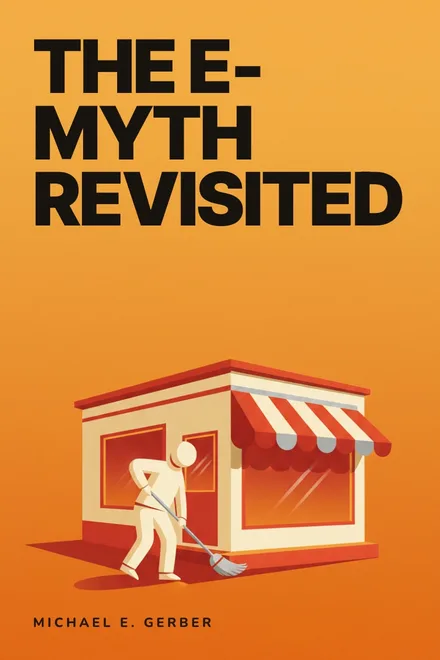
Business · Book summary
The E-Myth Revisited summary
Michael Gerber argues that most small businesses struggle because they’re started by skilled technicians who assume that knowing the work means knowing how to run a business. The fix is to work on your business, not just in it: design it as a system, like a franchise prototype, that delivers consistent results without depending on you.
The E-Myth Revisited summary: the core argument
The E-Myth Revisited: Why Most Small Businesses Don’t Work and What to Do About It, published in 1995, updates Gerber’s 1986 book The E-Myth. The E stands for entrepreneur, and the myth is that most small businesses are started by entrepreneurs.
In Gerber’s experience as a small-business consultant, they mostly aren’t. They’re started by technicians: a baker, a plumber, a designer, someone good at the work who gets tired of working for someone else. Gerber calls this moment an entrepreneurial seizure. The new owner assumes that because they understand the technical work, they understand a business that does that work. Gerber calls that the fatal assumption.
The result is that the owner swaps one boss for a worse one. They do all the work, plus the bookkeeping, hiring and selling, and the business can’t grow beyond the hours they can personally put in. Gerber follows Sarah, who opened a pie shop because she loved baking and now finds she hates it.
His remedy is to think like a franchisor. A franchise such as McDonald’s works because every part of it is a documented system that ordinary people can run to a consistent standard. Gerber argues every small business should be built as if it were the prototype for a thousand copies, whether or not it’s ever franchised. That shift, from doing the work to designing how the work gets done, is what he calls working on your business rather than in it.

Key ideas from The E-Myth Revisited
The book’s main ideas, each with one practical takeaway. In BrainDrop, The E-Myth Revisited is 7 short illustrated cards with a quick quiz at the end; this page is the written version.
1Being good at the work isn’t running a business
Sarah’s pie shop runs through the book. She bakes brilliant pies, but she spends her days baking, serving, cleaning and doing the books, and the joy has gone. Her skill as a baker doesn’t tell her how to build a business around baking.
Gerber’s point is that technical skill and business skill are different jobs, and most owners only ever trained for the first.
Try this
List everything you did in your work last week, and mark which tasks used your technical skill and which were about running the business.
2Three people in one
Gerber says every business owner contains three personalities. The Entrepreneur is the visionary who dreams about the future. The Manager is the planner who wants order and systems. The Technician is the doer who wants to get on with the work.
In most small businesses, the Technician dominates and the other two are starved. A healthy business needs all three in balance.
Try this
Estimate what share of your time goes to dreaming, planning and doing. Pick one hour this week for the role you neglect.
3Delegation without systems is abdication
When owners get overwhelmed, they often hand work to someone else and hope for the best. Without a clear, written way of doing the job, Gerber calls this abdication rather than delegation, and it usually ends with the owner taking the work back in frustration.
He describes a business’s growth in stages, from infancy, when the owner is the business, through adolescence, when they first get help, to maturity, which is designed from the start.
Try this
Before handing off your next task, write a one-page checklist of how it should be done and what ‘done well’ looks like.
4Build a franchise prototype
The heart of the book is the turn-key revolution. Gerber holds up McDonald’s as a business so well systematised that it works with ordinary staff following clear processes. You don’t need to franchise, he argues, but you should build as though you might.
A prototype business delivers consistent value, can be run by people with modest skills, is documented in operations manuals, and looks and works the same every time.
Try this
Pick the one process in your business that happens most often and document it so a new person could follow it on their first day.
5Systems make quality consistent
Gerber recalls staying at a small hotel where everything was right: the room was ready, his preferences were remembered on his next visit, details were taken care of without his asking. The magic wasn’t exceptional staff but a system that made ordinary staff deliver an exceptional experience every time.
Relying on brilliant people is fragile; brilliant systems let good people succeed.
Try this
Think of a moment when a customer was delighted. Write down what produced it and how you could make it happen every time.

6Innovate, quantify, orchestrate
Gerber’s business development process has three parts. Innovation means trying a better way of doing something, even a small change in a greeting or a form. Quantification means measuring the effect. Orchestration means making whatever works the standard, so it happens every time.
His example is a simple question asked to customers: “Have you been here before?” Each answer leads to a scripted next step that makes them feel looked after, and the effect can be measured.
Try this
Test one small change with customers this week, count the result, and if it works, write it into how things are done.
7Follow the seven-step programme
The final part of the book sets out a business development programme in seven steps: your primary aim (what you want your life to be), your strategic objective (what the business must achieve to serve that), then your organisational, management, people, marketing and systems strategies.
Starting with the primary aim matters. The business is meant to serve your life, not the other way round.
Try this
Write a short paragraph describing the life you want in ten years, then one line on what your business must do to support it.
8Work on it, not just in it
The phrase most people take from the book is the difference between working in your business, doing the daily tasks, and working on it, designing how those tasks get done.
Gerber argues that until owners make time for the second, they’ll never escape the first.
Try this
Block one hour a week as ‘on the business’ time and protect it as firmly as a client meeting.
The E-Myth Revisited quotes
Quoted from the book and checked against it.
“The Fatal Assumption is: If you understand the technical work of a business, you understand a business that does technical work.”
How the book is structured
The E-Myth Revisited has three parts, with Sarah’s pie shop as a thread that runs through them.
- Part I: The E-Myth and American small business The entrepreneurial seizure, the three personalities of an owner, and the infancy, adolescence and maturity of a business.
- Part II: The Turn-Key Revolution The franchise prototype, why systems beat people, and the business development process of innovation, quantification and orchestration.
- Part III: Building a small business that works The seven-step business development programme, from primary aim to systems strategy.
Who should read The E-Myth Revisited?
The E-Myth Revisited is for freelancers, sole traders and small-business owners who feel their business owns them. It’s also useful before starting a business, to see the trap before you fall into it.
Readers running larger companies, or who already have strong operations, may find it basic. Its examples are mostly service businesses such as shops, salons and trades.
Criticisms of The E-Myth Revisited
Readers often find the book repetitive and the dialogue with Sarah stilted. The ideas could be stated in far fewer pages, and some find the tone preachy.
Others argue that heavy systematisation suits restaurants and repeatable services better than creative or highly skilled work, where judgement matters more than scripts. It also says little about funding, product or market. Even so, many owners credit it with the single shift that changed their business: building systems instead of doing everything themselves.
Books like The E-Myth Revisited




The E-Myth Revisited summary: questions
What is the E-Myth?
The entrepreneurial myth: the belief that most small businesses are started by entrepreneurs. Gerber argues they’re mostly started by technicians who know the work but not how to run a business.
What are the three roles in The E-Myth?
The Entrepreneur (the visionary), the Manager (the planner and organiser) and the Technician (the doer). Gerber says owners need all three, but most are stuck as the Technician.
What does ‘work on your business, not in it’ mean?
Spend time designing systems for how the work is done, rather than spending all your time doing the work yourself.
What is a franchise prototype?
A business built so that its processes are documented and repeatable, so it could be copied and run by ordinary people to a consistent standard, whether or not it’s ever franchised.
Is The E-Myth Revisited worth reading?
Yes, if you own or plan to start a small business and feel stuck doing everything yourself. If you already run strong systems, a summary may be enough.
The E-Myth vs The E-Myth Revisited: what’s the difference?
The E-Myth Revisited (1995) is an updated, expanded version of the original 1986 book, with the Sarah pie shop story woven through. Most readers start with Revisited.
Read The E-Myth Revisited as illustrated cards in BrainDrop
The 7 ideas from The E-Myth Revisited, each told as a short illustrated story with one small thing to try today, then a quick quiz to make it stick. Free to download, with a free trial.
- Sarah’s Pie Shop
- Three People in One
- When the Owner Is the Business
- The Franchise Prototype
- The Hotel That Got It Right
- Have You Been Here Before?
- Working On It
Choosing an app?
The best book summary apps in 2026, compared · BrainDrop vs Nibble · Best book summary apps in 2026