Money · Book summary
Die with Zero summary
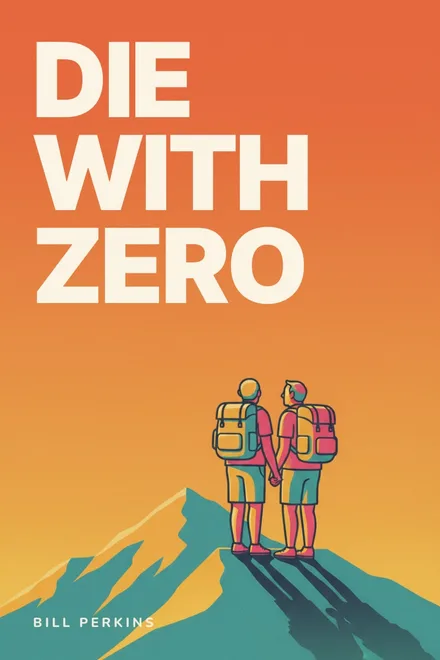
Bill Perkins argues that most people save too much for too long and die with money they never got to enjoy. Your life is the sum of your experiences, and your health and free time to enjoy them shrink with age. So plan to spend down your wealth deliberately, give while you’re alive, and take your experiences while you can.
Die with Zero summary: the core argument
Die With Zero: Getting All You Can from Your Money and Your Life was published in 2020. Bill Perkins is an American hedge fund manager and energy trader, and the book is his challenge to the usual personal finance message that more saving is always better.
He opens with Aesop’s fable of the ant, who works all summer, and the grasshopper, who plays. We’re taught to be the ant. Perkins asks a question the fable skips: when does the ant get to play? Many people work and save diligently, then die with large sums untouched, which means they gave away years of their life for money they never used.
His alternative is to aim to maximise lifetime fulfilment rather than wealth. Money is only valuable as a means to experiences, and the value of an experience depends on when you have it. A backpacking trip at twenty-five is a different thing at seventy-five. Health, energy and free time rise and fall across a life, so spending should be timed to match.
Perkins organises the book around nine rules, from investing in experiences early to knowing when to stop growing your wealth. He admits that dying with exactly zero is impossible to hit precisely; the title is a direction, not a literal target. The aim is to spend your money on purpose while it can still buy the life you want.

Key ideas from Die with Zero
The book’s main ideas, each with one practical takeaway. In BrainDrop, Die with Zero is 9 short illustrated cards with a quick quiz at the end; this page is the written version.
1Maximise your life experiences
Perkins’s first rule is that the business of life is collecting good experiences. Money matters only because it buys them, so the goal is the richest life, not the biggest balance.
He suggests thinking in terms of net fulfilment: the total enjoyment you get across a lifetime from the experiences your time and money allow.
Try this
Write a list of ten experiences you’d love to have, then note roughly what each would cost in money and time.
2Collect memory dividends
A great experience pays twice: once when you have it, and again every time you remember it, retell it or look at the photos. Perkins calls this the memory dividend.
Because the dividend keeps paying, experiences had earlier in life are worth more. A trip at thirty gives decades of memories; the same trip at eighty gives few.
Try this
Move one experience on your list forward by a year or more, and notice how that changes how long you’ll enjoy the memory.
3Plan your life in time buckets
Perkins suggests dividing your life into five- or ten-year buckets and placing each experience you want in the bucket where it fits best. Some are only possible while you’re young and fit, others need children of a certain age, others suit later life.
This turns a vague bucket list into a timetable, and shows which experiences you’re at risk of missing for good.
Try this
Draw buckets for the next three decades of your life and put each of your ten experiences into one of them.
4Health is your real currency
The ability to enjoy money declines as health fades. Perkins shows that spending typically drops as people age, not always because they’ve run out of money, but because they can do less with it.
He argues that investing in your health has the biggest effect on how much enjoyment every other pound can buy.
Try this
Pick one health habit, such as sleep, strength training or walking, that would let you enjoy the experiences in your later buckets.
5Give while you’re alive
Perkins points out that heirs often inherit when they are around sixty, long after money would have made the biggest difference to their lives. He suggests giving to your children when they need it most, such as for a home or education, and seeing the impact yourself.
The same applies to charity: give during your lifetime and watch the good it does, rather than leaving it all in a will.
Try this
If you plan to leave money to someone, ask when it would help them most, and whether some of it could go to them sooner.

6Find your peak net worth
Most people never decide when to stop accumulating. Perkins argues there is an optimal point, often somewhere between the mid-forties and around sixty depending on your circumstances, to stop growing wealth and start spending it down.
To manage the fear of running out, he suggests tools such as annuities, which turn savings into guaranteed income for life.
Try this
Estimate the amount you need to fund the rest of your life, including a safety margin. Note how far you are from it.
7Take your biggest risks early
When you’re young, failure costs little and you have decades to recover. Perkins argues this is the time for bold moves: a career change, a move abroad, a start-up. Older people have more to lose and less time to bounce back.
Playing it too safe early can be the riskiest choice of all, because it wastes the years when risk is cheapest.
Try this
Write down one bold move you’ve been putting off and ask what the real downside would be if it failed.
8Don’t live on autopilot
Underneath every rule is the warning against drifting. People keep working, saving and postponing out of habit, not by choice.
Perkins wants readers to make deliberate decisions about money and time each year, rather than letting default settings decide their life for them.
Try this
Book one experience from your list into your calendar this month, with a date and a budget.
Die with Zero quotes
Quoted from the book and checked against it.
“Nothing has a greater effect on your ability to enjoy experiences—at any age—than your health.”
How the book is structured
Die With Zero is built around nine rules, each with its own chapter.
- Rules 1 to 3 Maximise your positive life experiences, start investing in experiences early, and aim to die with zero.
- Rule 4 Use all available tools, such as annuities, to help you spend down safely.
- Rule 5 Give money to your children or to charity when it will have the most impact.
- Rules 6 and 7 Don’t live your life on autopilot, and think of your life as distinct seasons.
- Rules 8 and 9 Know when to stop growing your wealth, and take your biggest risks early in life.
Who should read Die with Zero?
Die With Zero is for diligent savers who suspect they’re postponing life too much, and for people in their thirties to fifties planning how to balance saving and living. It’s short, warm and easy to read.
If you’re struggling to save at all, or have no safety net, much of its advice doesn’t yet apply. Start with a book on building foundations, such as I Will Teach You to Be Rich or The Psychology of Money.
Criticisms of Die with Zero
Critics point out that Perkins is very wealthy, which makes spending down far less risky for him than for most readers. Long-term care, inflation and living longer than expected can make running low on money a real danger.
Some financial planners also argue that annuities are expensive or unavailable in some countries, and that the book underplays emergencies and uncertainty. Supporters answer that the book is aimed at people who already over-save, and that it changes how they think about the purpose of money.
Books like Die with Zero

Die with Zero summary: questions
What is the main idea of Die With Zero?
That money is only valuable for the experiences it buys, so you should spend it deliberately during your life, while you can enjoy it, rather than dying with savings you never used.
What are the 9 rules of Die With Zero?
Maximise positive life experiences; invest in experiences early; aim to die with zero; use tools like annuities; give to children and charity when it has the most impact; don’t live on autopilot; think of life as seasons; know when to stop growing wealth; and take your biggest risks early.
What is a memory dividend?
The ongoing enjoyment you get from remembering and retelling an experience after it happens. Earlier experiences pay memory dividends for longer.
Does Die With Zero mean spending all your money?
Not literally. Perkins says hitting exactly zero is impossible; the aim is to spend down deliberately, keep a safety margin, and avoid dying with large sums you never needed.
Is Die With Zero worth reading?
Yes, especially if you’re a natural saver who postpones enjoyment. It’s less relevant if you don’t yet have savings or a safety net.
Die With Zero vs The Psychology of Money: which should I read?
The Psychology of Money focuses on behaviour and building wealth calmly. Die With Zero focuses on when and how to spend it. They work well together.
Read Die with Zero as illustrated cards in BrainDrop
The 9 ideas from Die with Zero, each told as a short illustrated story with one small thing to try today, then a quick quiz to make it stick. Free to download, with a free trial.
- Maximize Life Experiences
- The Memory Dividend
- Plan With Time Buckets
- Health Is Your Real Currency
- Give While You’re Alive
- Donate Now, Not Later
- Hedge Longevity With Annuities
- Find Your Peak Net Worth
- Take Bold Risks Young
Choosing an app?
Free book summary apps for iPhone · BrainDrop vs Nibble · Best book summary apps in 2026